Research & PublicationsExploring scientific questions through research, writing, and publication.
Research has given me the opportunity to explore scientific questions beyond the classroom while developing skills in critical thinking, scientific communication, and collaboration.
Whether conducting experiments, analyzing data, or synthesizing emerging research, I have enjoyed the process of transforming complex scientific questions into meaningful contributions that can be shared with the broader scientific community. This page highlights my published work and ongoing research projects.
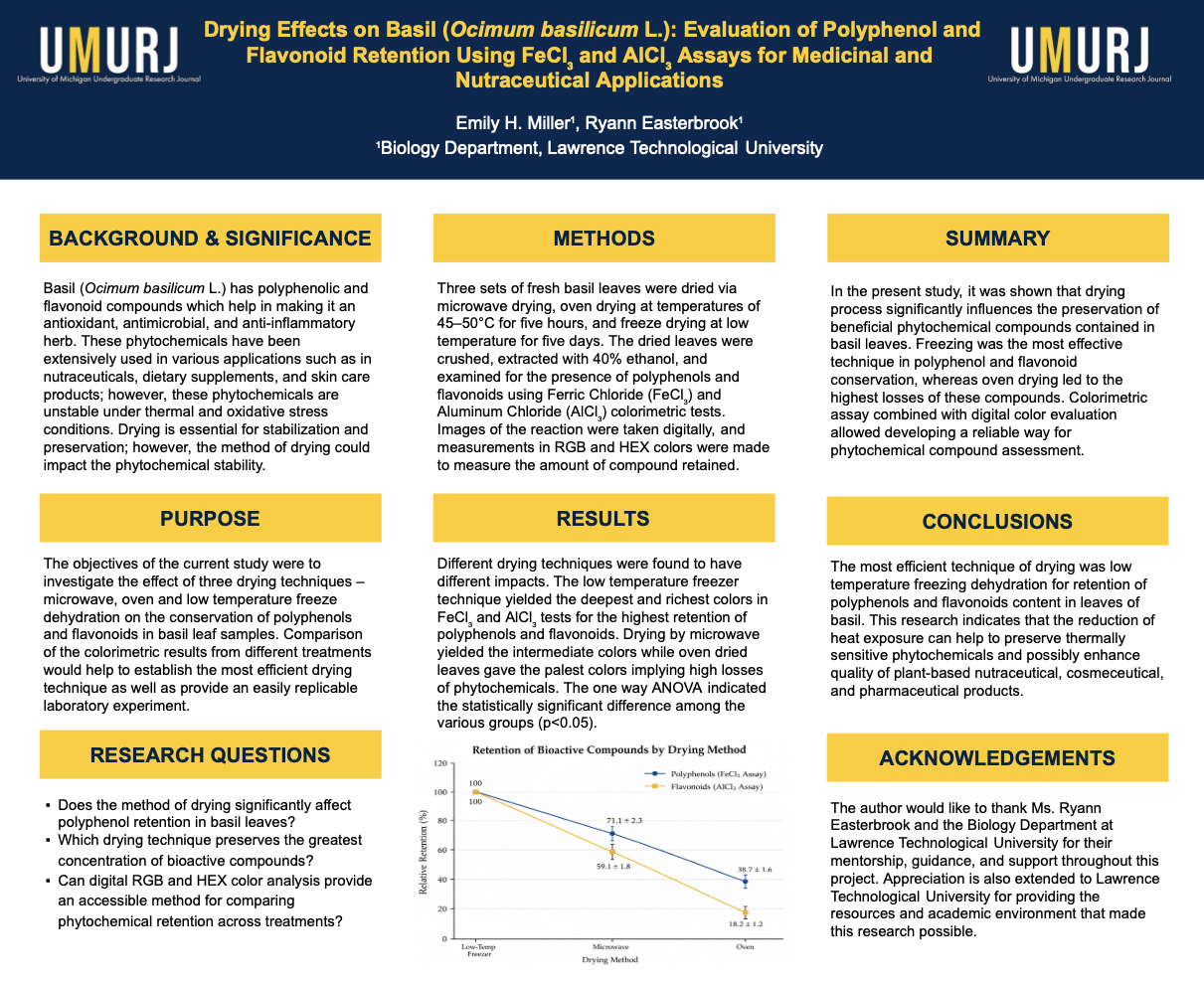
Drying Effects on Basil (Ocimum basilicum L.):
Evaluation of Polyphenol and Flavonoid Retention Using FeCl₃ and AlCl₃ Assays for Medicinal and Nutraceutical Applications
University of Michigan Undergraduate Research Journal
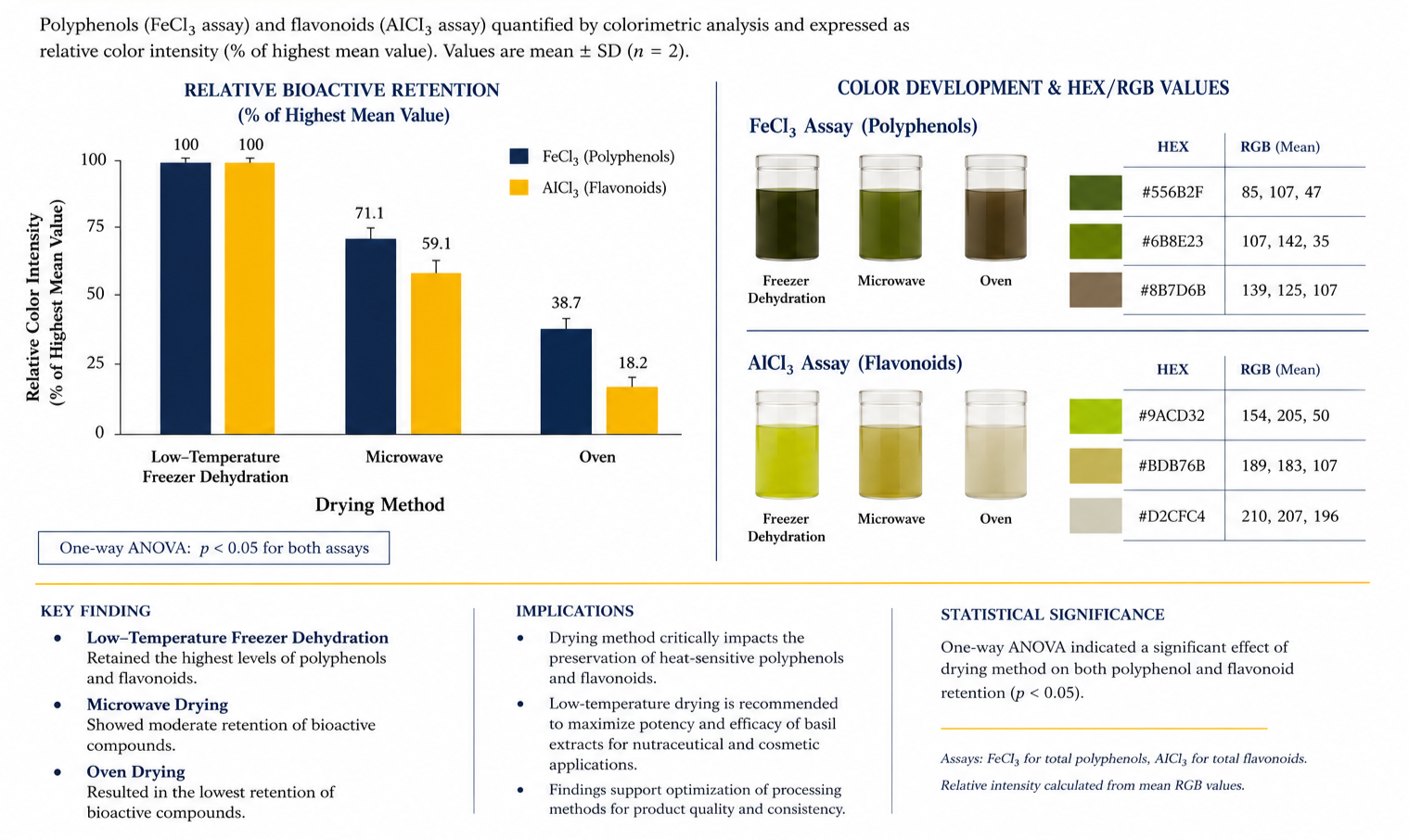
Many cosmetic, pharmaceutical, and nutraceutical products rely on plant-derived ingredients, but manufacturing processes can degrade heat-sensitive compounds, reducing their potency, stability, and effectiveness. This study investigated how three common drying methods, microwave drying, oven drying, and low-temperature freezer dehydration, influenced the retention of polyphenols and flavonoids in Ocimum basilicum (basil). Following each drying treatment, ethanol extracts were analyzed using ferric chloride (FeCl₃) and aluminum chloride (AlCl₃) colorimetric assays, with quantitative RGB and HEX image analysis used to compare phytochemical retention. Statistical analysis identified significant differences between the drying methods, with low-temperature freezer dehydration preserving the highest concentration of bioactive compounds.
The findings demonstrate how manufacturing decisions can directly influence the chemical integrity of botanical ingredients before they are incorporated into consumer products. As plant-derived compounds continue to play an expanding role in cosmetics, pharmaceuticals, and nutraceuticals, understanding these relationships can help optimize formulation strategies, improve batch-to-batch consistency, reduce material waste, and support the development of more reliable plant-based therapies and formulations.
Dermatologic Lasers: Comprehensive Review of Cosmetic and Therapeutic Uses
Journal of Dermatology Research and Therapy
Topical medications are widely used to treat dermatologic conditions, but their effectiveness is often limited by the skin's natural barrier, which restricts drug penetration into deeper tissue. Laser-assisted drug delivery (LADD) has emerged as a promising approach to overcome this challenge by using fractional laser technologies to create microscopic treatment channels that temporarily increase skin permeability, enhancing localized drug delivery while minimizing systemic exposure.
This publication explored how advances in laser-assisted drug delivery are expanding treatment options for a variety of dermatologic conditions, including hypertrophic scars, pigmentary disorders, inflammatory skin diseases, and cutaneous malignancies. By evaluating current clinical evidence and emerging applications, the research examined how laser parameters, drug selection, and treatment protocols influence therapeutic outcomes while identifying opportunities to improve the precision and effectiveness of topical therapies. The publication also incorporated insights from a cosmetic dermatologist practicing at Henry Ford, providing a clinical perspective on the current state and future direction of LADD. By synthesizing current research and clinical perspectives, this publication highlights the potential of LADD to improve treatment efficacy, reduce systemic exposure, and support the continued advancement of precision dermatology.
Ongoing Research
Scientific discovery is an iterative process, and several additional projects are currently progressing toward publication. These studies build upon my interests in drug delivery, formulation science, biomaterials, and tissue engineering while exploring practical solutions to challenges in biomedical research. Although still in preparation, they reflect my continued commitment to investigating questions with real-world scientific and clinical applications.
Comparative Evaluation of Synthetic Hydrogel and Biological Membrane Models for In Vitro Assessment of Transdermal Drug Delivery Kinetics
Developing effective transdermal drug delivery systems requires understanding how formulation vehicles and biological barriers influence molecular diffusion. This study compared two accessible in vitro diffusion models, synthetic agar hydrogel and biological chicken eggshell membrane, to evaluate how different formulation vehicles affected the transport of model compounds. By quantifying diffusion depth, permeation, and concentration using image analysis and statistical modeling, the research demonstrated that formulation viscosity and barrier composition play critical roles in transdermal transport. These findings support the use of inexpensive diffusion models for preliminary formulation screening while highlighting the importance of formulation design in optimizing topical and transdermal drug delivery systems.
Manuscript under review for publication.
Influence of Environmental pH and Salinity on Tissue Integrity and Degradation in Solanum tuberosum as a Biological Tissue Model
Maintaining tissue integrity is fundamental to biomedical research, tissue engineering, and regenerative medicine. This study investigated how environmental pH and salinity influence tissue degradation using Solanum tuberosum as an accessible biological tissue model. By evaluating structural changes under controlled acidic and saline conditions, the research examined how osmotic and chemical stressors affect tissue stability. Understanding these effects can help inform strategies for optimizing tissue preservation and improving the design of experimental models. The observed structural changes are consistent with the effects of osmotic imbalance and altered cellular permeability induced by variations in pH and salinity. Although a simplified model, the findings provide insight into tissue preservation, experimental modeling, and the development of more reliable biomaterial systems.
Manuscript under review for publication.